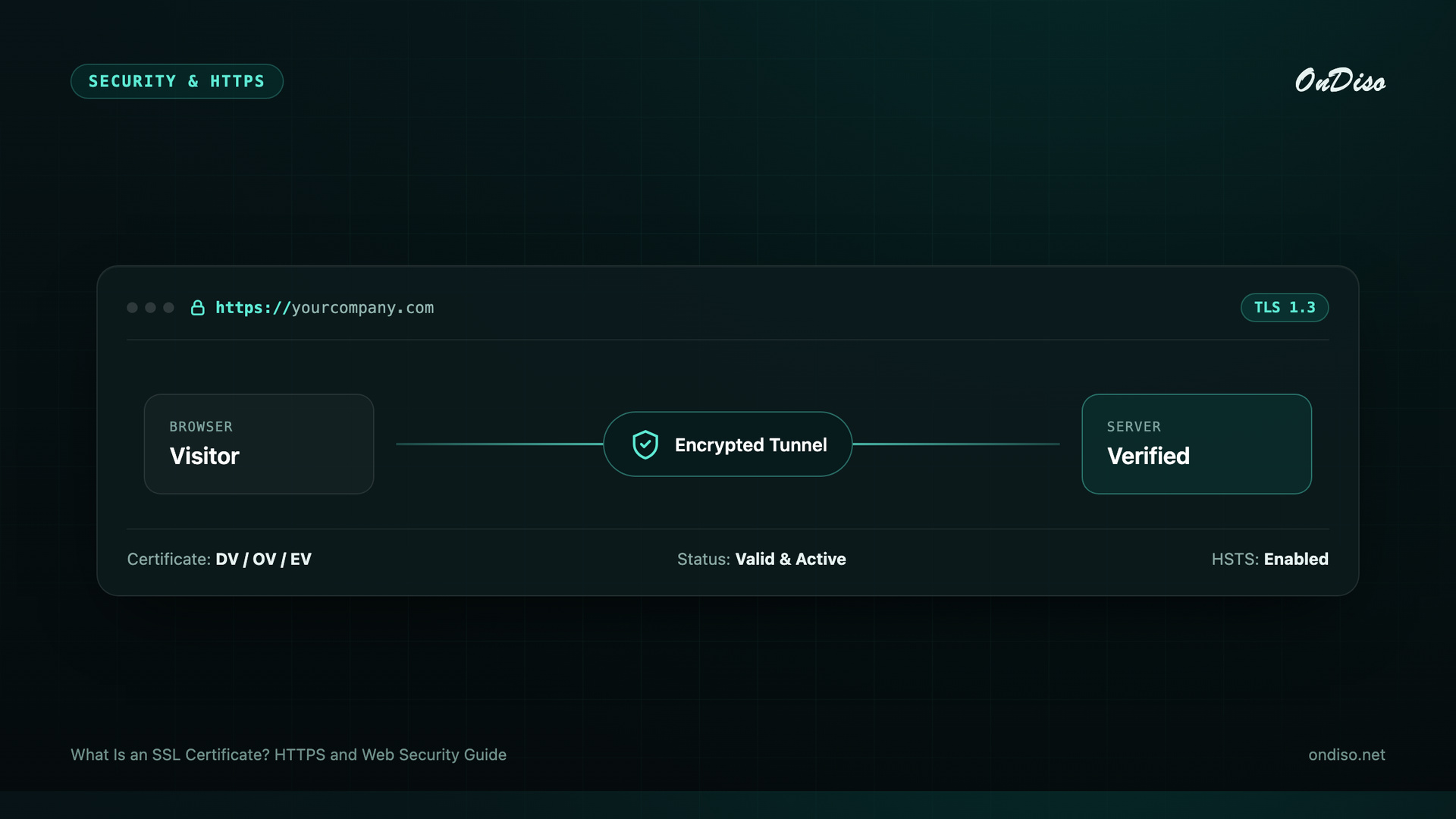
An SSL (today TLS) certificate is a digital credential that encrypts all data exchanged between a visitor's browser and a web server over HTTPS. It protects forms and logins from interception, removes browser security warnings, and acts as a baseline trust and ranking signal on Google.
How Does an SSL/TLS Connection Work?
When a visitor opens an https:// URL, a TLS handshake completes between the browser and web server in milliseconds. The server presents its valid certificate, the browser verifies it, and all subsequent traffic flows through an encrypted channel.
This keeps contact forms, admin sessions, and e-commerce checkouts protected even on public Wi-Fi networks. Paired with a properly configured domain name and DNS setup, HTTPS is an essential baseline for every business website.
SSL Certificate Types and Selection Criteria
The validation level you need depends on your site type and compliance goals:
| Type | Validation Scope | Best Use Case |
|---|---|---|
| DV (Domain Validated) | Domain ownership verification only | Corporate sites, blogs, and fast launches |
| OV (Organization Validated) | Domain + legal company identity verification | Enterprise portals and B2B platforms |
| EV (Extended Validation) | Full legal and commercial vetting | Banking, fintech, and high-volume e-commerce |
| Wildcard SSL | Root domain plus all subdomains (*.ondiso.net) | Multi-subdomain SaaS architectures |
HTTPS SEO Impact and Common Setup Pitfalls
Google treats HTTPS as a direct ranking signal. However, installing a certificate is only step one; three technical checks prevent issues:
- 301 HTTP → HTTPS Redirect: Serving pages on both
http://andhttps://creates duplicate URLs; force a single clean 301 redirect to HTTPS. - Mixed Content Errors: Even one image or script loaded over
http://inside an HTTPS page triggers browser trust warnings. - Auto-Renewal and Chain Health: Expired certificates block visitors with full-screen warnings; automated renewal and complete intermediate chains must be monitored.
Frequently Asked Questions
Is there a security encryption difference between Let's Encrypt and paid SSL certificates?
No technical encryption difference exists—both support TLS 1.3 and 256-bit ciphers. Paid certificates are primarily used when legal company vetting (OV/EV), warranty guarantees, or legacy device compatibility are required.
Why can Google rankings fluctuate briefly right after enabling SSL?
If 301 redirects, canonical tags, and sitemap.xml URLs are not updated together during an HTTP-to-HTTPS migration, indexing may briefly reprocess. Once all URLs align on HTTPS, visibility stabilizes quickly.
Let's plan your project together
Corporate web engineering, e-commerce, custom SaaS, business email plans, or technical SEO — tell us what you are building.